 Add to Chrome
 Add to Firefox
 Add to Edge
Rethinking Noise-Robust Training for Frozen Vision Foundation Models: A Cross-Dataset Benchmark with a Case Study of Small-Loss Failure
May 21, 2026
Frozen Vision Foundation Models (VFMs) with lightweight classification heads are increasingly used in medical imaging because they offer efficient and reproducible deployment. Yet noisy-label learning methods for this frozen-feature regime remain poorly understood, and most existing methods still rely on a small-loss assumption inherited from end-to-end training. We present a controlled benchmark of eight noisy-label methods across five medical datasets, three backbones, two noise types, and five noise rates (150 conditions, 6,000 training runs), evaluated with balanced accuracy. The benchmark shows that there is no universal winner: Friedman ranking over the 150 conditions yields $χ^2 = 333.2$ ($p = 4.77 \times 10^{-68}$), ELR wins the most conditions (49/150), while CUFIT attains the best mean rank (2.51). The practical cost of method choice grows sharply with noise severity, from 4.5pp on clean data to 18.8pp at asymmetric 40\% noise. To explain these benchmark-level patterns, we revisit the small-loss assumption in a representative high-risk regime. Under frozen DINOv2 features, clean and noisy loss distributions overlap by 53--61\%, and matched-rate clean-sample detection shows that prediction agreement is markedly more stable than loss ranking under asymmetric noise (3pp vs.\ 13pp precision drop). On ISIC2019 with asymmetric 40\% noise, Co-Teaching reaches 68\% overall accuracy while collapsing to 35.1\% balanced accuracy with zero recall on three minority classes. Together, these results recast noisy-label learning for frozen VFMs as a regime-aware method-selection problem rather than a search for a single dominant algorithm. We conclude with evidence-based guidance and a low-regret feature-space selector for practical recommendation.

HalluCXR: Benchmarking and Mitigating Hallucinations in Medical Vision-Language Models for Chest Radiograph Interpretation
May 19, 2026Vision-language models (VLMs) are increasingly used for medical image interpretation, yet they frequently hallucinate, generating clinically plausible but factually incorrect findings that pose direct patient safety risks. We introduce HalluCXR, a benchmark evaluating six architecturally diverse VLMs across 856 stratified MIMIC-CXR chest radiographs and three query types, yielding 15,408 model evaluations. An eight-category hallucination taxonomy with clinical severity ratings and a two-layer detection pipeline are validated against 250 human annotations (auto-detection F1=0.959; LLM judge F1=0.907). We find that 61.9--82.3% of outputs contain hallucinations, with clinically dangerous errors in up to 80.2%. Three key patterns emerge: normal radiographs paradoxically attract the most severe hallucinations, common findings are systematically over-fabricated while rare findings go under-detected, and response length alone predicts hallucination risk (AUC up to 0.908). A six-model ensemble reduces fabrication by up to 84.8% at the cost of increased omission; a three-model subset retains comparable performance at half the cost. These results establish that hallucination auditing, verbosity-based risk monitoring, and ensemble-based safety layers are prerequisites for clinical deployment.
From Domains to Instances: Dual-Granularity Data Synthesis for LLM Unlearning
Jan 07, 2026Although machine unlearning is essential for removing private, harmful, or copyrighted content from LLMs, current benchmarks often fail to faithfully represent the true "forgetting scope" learned by the model. We formalize two distinct unlearning granularities, domain-level and instance-level, and propose BiForget, an automated framework for synthesizing high-quality forget sets. Unlike prior work relying on external generators, BiForget exploits the target model per se to elicit data that matches its internal knowledge distribution through seed-guided and adversarial prompting. Our experiments across diverse benchmarks show that it achieves a superior balance of relevance, diversity, and efficiency. Quantitatively, in the Harry Potter domain, it improves relevance by ${\sim}20$ and diversity by ${\sim}$0.05 while halving the total data size compared to SOTAs. Ultimately, it facilitates more robust forgetting and better utility preservation, providing a more rigorous foundation for evaluating LLM unlearning.
Fused3S: Fast Sparse Attention on Tensor Cores
May 12, 2025
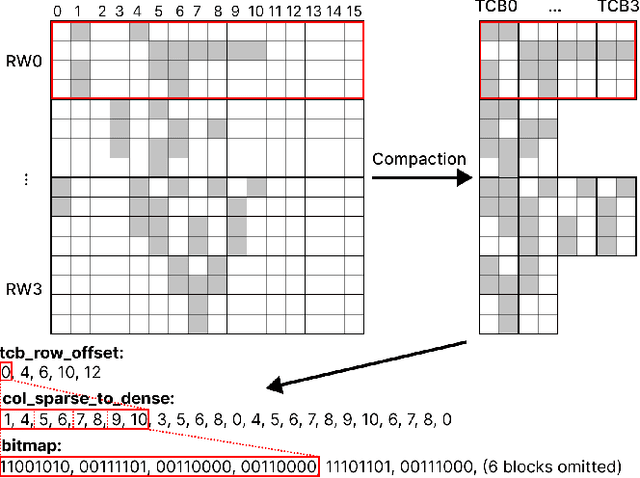
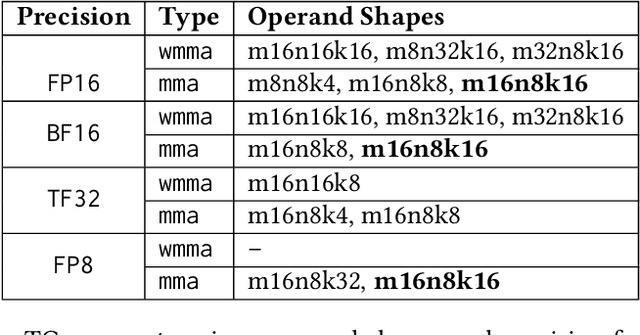
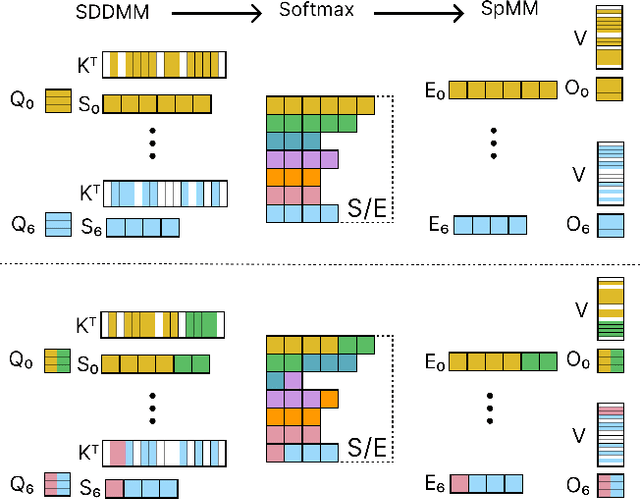
Sparse attention is a core building block in many leading neural network models, from graph-structured learning to sparse sequence modeling. It can be decomposed into a sequence of three sparse matrix operations (3S): sampled dense-dense matrix multiplication (SDDMM), softmax normalization, and sparse matrix multiplication (SpMM). Efficiently executing the 3S computational pattern on modern GPUs remains challenging due to (a) the mismatch between unstructured sparsity and tensor cores optimized for dense operations, and (b) the high cost of data movement. Previous works have optimized these sparse operations individually or addressed one of these challenges. This paper introduces Fused3S, the first fused 3S algorithm that jointly maximizes tensor core utilization and minimizes data movement. Across real-world graph datasets, Fused3S achieves $1.6- 16.3\times$ and $1.5-14\times$ speedup over state-of-the-art on H100 and A30 GPUs. Furthermore, integrating Fused3S into Graph Transformer inference accelerates end-to-end performance by $1.05-5.36\times$, consistently outperforming all 3S baselines across diverse datasets (single and batched graphs) and GPU architectures.
FUNU: Boosting Machine Unlearning Efficiency by Filtering Unnecessary Unlearning
Jan 28, 2025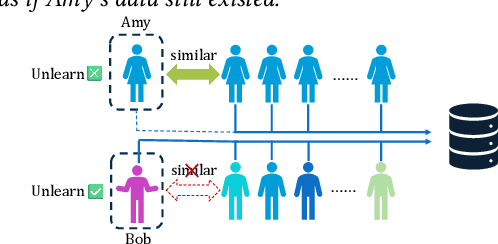
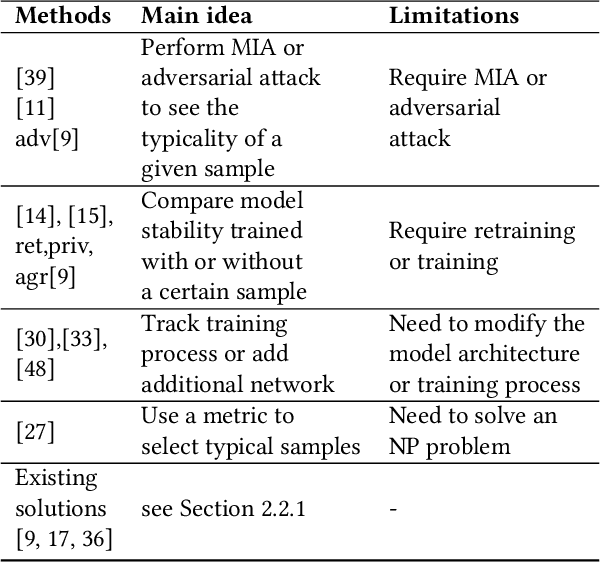
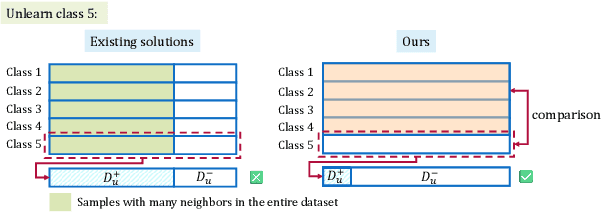
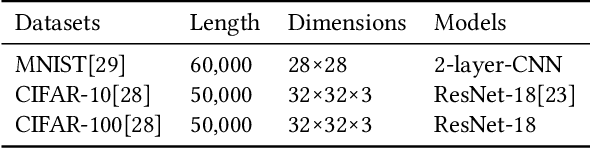
Machine unlearning is an emerging field that selectively removes specific data samples from a trained model. This capability is crucial for addressing privacy concerns, complying with data protection regulations, and correcting errors or biases introduced by certain data. Unlike traditional machine learning, where models are typically static once trained, machine unlearning facilitates dynamic updates that enable the model to ``forget'' information without requiring complete retraining from scratch. There are various machine unlearning methods, some of which are more time-efficient when data removal requests are fewer. To decrease the execution time of such machine unlearning methods, we aim to reduce the size of data removal requests based on the fundamental assumption that the removal of certain data would not result in a distinguishable retrained model. We first propose the concept of unnecessary unlearning, which indicates that the model would not alter noticeably after removing some data points. Subsequently, we review existing solutions that can be used to solve our problem. We highlight their limitations in adaptability to different unlearning scenarios and their reliance on manually selected parameters. We consequently put forward FUNU, a method to identify data points that lead to unnecessary unlearning. FUNU circumvents the limitations of existing solutions. The idea is to discover data points within the removal requests that have similar neighbors in the remaining dataset. We utilize a reference model to set parameters for finding neighbors, inspired from the area of model memorization. We provide a theoretical analysis of the privacy guarantee offered by FUNU and conduct extensive experiments to validate its efficacy.
Breaking Boundaries: Distributed Domain Decomposition with Scalable Physics-Informed Neural PDE Solvers
Aug 28, 2023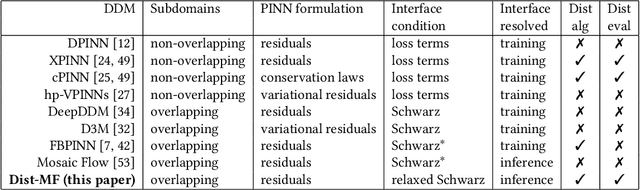
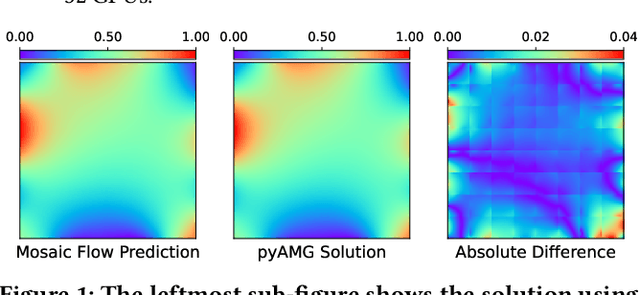

Mosaic Flow is a novel domain decomposition method designed to scale physics-informed neural PDE solvers to large domains. Its unique approach leverages pre-trained networks on small domains to solve partial differential equations on large domains purely through inference, resulting in high reusability. This paper presents an end-to-end parallelization of Mosaic Flow, combining data parallel training and domain parallelism for inference on large-scale problems. By optimizing the network architecture and data parallel training, we significantly reduce the training time for learning the Laplacian operator to minutes on 32 GPUs. Moreover, our distributed domain decomposition algorithm enables scalable inferences for solving the Laplace equation on domains 4096 times larger than the training domain, demonstrating strong scaling while maintaining accuracy on 32 GPUs. The reusability of Mosaic Flow, combined with the improved performance achieved through the distributed-memory algorithms, makes it a promising tool for modeling complex physical phenomena and accelerating scientific discovery.